
Teacup Dogs: Adorable or Health Risk?
Small breed dogs, such as the charming Yorkshire Terrier featured here, offer fantastic companionship and maintain excellent health throughout their lives. Challenges arise, however, when certain breeders pursue the creation of exceptionally diminutive canines, commonly referred to as “teacup” dogs.

Small breed dogs, such as the charming Yorkshire Terrier featured here, offer fantastic companionship and maintain excellent health throughout their lives. Challenges arise, however, when certain breeders pursue the creation of exceptionally diminutive canines, commonly referred to as “teacup” dogs. Credit: Art Marie | Getty Images
It's easy to understand the appeal! These pint-sized pooches capture hearts with their cuteness. Yet, the label “teacup dog” frequently signals concerning breeding methods that prioritize extreme miniaturization over well-being. The good news is that you have plenty of options for acquiring a compact canine that remains healthy and lives a full lifespan without such risks.
There are numerous practical motivations for choosing a small dog. In urban environments, these little ones excel in apartment settings, especially where rental agreements impose strict weight restrictions on pets. They also travel effortlessly on public transportation systems. Frequent flyers appreciate how a petite pup can fit comfortably in a carrier beneath the airplane seat. Outdoor enthusiasts, including hikers, often favor them because they can be easily transported if the dog tires or sustains a minor injury during adventures. Above all, there's the timeless joy of having a cozy companion that nestles perfectly in your lap for affectionate snuggling sessions.
Ideal Small Dog Breeds for Long-Term Companionship
The majority of dogs that naturally remain compact into adulthood belong to the toy breed category. This “toy group” encompasses varieties specifically bred over generations to serve as affectionate, diminutive household companions. While various terrier breeds can also be small in stature, they typically exhibit higher levels of spunk, assertiveness, and boundless vitality.
Weight expectations fluctuate based on the specific breed, any crossbreeding, gender differences, and unique traits of the individual animal. Generally, dogs from the toy group and their mixes top out below 20 pounds as adults, with countless examples weighing considerably less. This reliable sizing predictability stems from the diligent work of responsible breeders across history, who established and upheld detailed breed standards serving as comprehensive guides for ideal physical and temperamental traits.
Deviations do happen occasionally, where a dog grows somewhat larger than typical for its lineage, but such instances are rare when sourcing from ethical breeders committed to breed standards. With mixed-breed puppies, size outcomes may show more variation compared to purebreds; nevertheless, if both sire and dam are small, the offspring are likely to follow suit in maintaining a petite build.
Distinguishing Standard Toy Dogs from Teacup Varieties
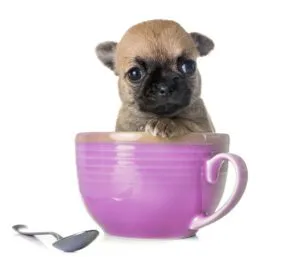
Unethical breeders manufacture these ultra-tiny versions of small dogs, marketed as “teacup” dogs, which carry a significant array of potential medical complications. Supplemental photo Credit: Cynoclub | Getty Images
Every teacup dog qualifies as a toy breed, but not every toy breed dog falls into the teacup classification. The phrase “teacup dog” functions primarily as a clever marketing gimmick, describing specimens that are extraordinarily undersized—sometimes to the point where they might theoretically squeeze into an actual teacup. This often translates to adult weights dipping below 5 pounds, though the term gets loosely attached to undersized individuals from breeds that are generally larger than toys.
No official breeds exist under the teacup umbrella; instead, it denotes particularly minuscule examples within established breeds. For instance, a teacup Chihuahua simply represents an especially tiny iteration of the Chihuahua breed, without constituting a distinct variety.
Popular toy breeds frequently entangled in this teacup trend encompass the Chihuahua, Maltese, Pomeranian, Poodle, and Yorkshire Terrier, among others.
Critical Health Drawbacks of Teacup Dogs
Teacup dogs themselves aren't innately flawed; the core issue lies in the human tendency to obsess over trendy labels, driving a surge in demand. A single high-profile celebrity sharing a snapshot of their minuscule furry friend can ignite widespread frenzy. Unscrupulous opportunists then rush to capitalize, churning out litters for profit without regard for consequences.
Producing robust, thriving dogs demands far more nuance than merely pairing two animals. Numerous behavioral tendencies, physical attributes, and hereditary conditions are governed by recessive genes invisible without thorough scrutiny. Seemingly robust dogs might harbor hidden genetic defects that severely impact their progeny. Thus, ethical breeders shoulder the duty to meticulously research each dog's personal history, pedigree, and familial health records to map out potential genetic risks comprehensively.
Toy breeds already carry predispositions to various ailments, and fixating solely on achieving minimal size exacerbates these vulnerabilities dramatically when breeding choices ignore health altogether.
Prevalent health concerns in toy breed dogs encompass:
- Luxating patella
- Collapsing trachea
- Portosystemic shunts
- Open fontanelle, which is essentially an unfused gap in the skull exposing the brain
- Legg Calve Perthes Disease
- Mitral valve disease
- Pancreatitis
- Periodontal disease
- Hypoglycemia
Any individual breeding toy breeds, including crossbreeds, must stay informed about these conditions' occurrence rates within their specific lines. Several can undergo targeted diagnostic testing. For Pomeranians, experts advocate comprehensive assessments via the Orthopedic Foundation for Animals (OFA) covering cardiac function, patellar stability, ocular health, thyroid function, hip structure, and Legg-Calve-Perthes evaluations for all prospective breeding dogs.
The OFA website, through its Canine Health Information Center resources, details breed-specific recommended screenings. For mixed-breed litters, investigate testing protocols for every contributing breed; prioritize those advised across multiple breeds for maximal benefit.
Teacup breeders routinely skip such vital health evaluations. Repeating this negligence across successive generations rapidly amplifies defect prevalence within bloodlines, inflicting suffering, exorbitant veterinary expenses, and potentially lethal outcomes on the dogs.
Temperament Challenges in Ultra-Tiny Dogs
An obsession with breeding the smallest possible puppies can compromise temperament and early socialization efforts. Pups inheriting shyness or aggression from one or both parents will mirror those undesirable traits. A snarling Pomeranian might amuse momentarily, but it proves burdensome in daily life and complicates routine vet visits.
Young puppies thrive with controlled, positive exposures to diverse textures, scents, humans, fellow animals, and novel situations during their formative developmental windows. Toy breeds customarily depart breeders at a minimum of 12 weeks old, underscoring the breeder's obligation to implement structured socialization strategies equipping puppies for lifelong adaptability.
Prospective teacup buyers should probe breeders extensively about their socialization regimens. Devoted, welfare-focused breeders gladly elaborate; trend-chasing profiteers typically evade or lack substantive responses.
Intensive Daily Care Demands of Tiny Dogs
Their minuscule proportions render teacup dogs profoundly delicate, necessitating heightened vigilance and specialized routines beyond those for bigger breeds.
Bones as slender as matchsticks fracture readily from mundane mishaps like leaping from furniture, accidental drops during handling, or entrapment in closing doors. They face constant peril from inadvertent stepping or sitting by unaware household members or other animals.
Both toy and teacup dogs risk hypoglycemia, characterized by dangerously low blood glucose. Puppies demand a minimum of three daily feedings, frequently escalating to four or five, to stabilize levels. Even mature teacups often thrive on multiple small meals spaced throughout the day to avert crises.
High surface-area-to-volume ratios make tiny dogs susceptible to hypothermia, particularly in cooler conditions. Provision cozy bedding, sweaters, jackets, and indoor potty solutions like pee pads during frigid weather to safeguard their comfort and safety.
Expected Lifespan of Teacup Dogs
While toy breed lifespans span into the mid-to-upper teens depending on the variety, teacup dogs frequently endure abbreviated existences due to compounded health frailties and structural weaknesses, potentially lopping off multiple years.
No outcome is assured, yet selecting from a proficient breeder conducting rigorous health clearances—and who can furnish detailed ancestral health and longevity data—maximizes odds of welcoming a vibrant, enduring companion into your home.
Weekly Digest
Top articles delivered to your inbox every week.